
How to Stay in One Place
December 4, 2025 • 5 min. • 937 words
Most street photography advice is about movement. Walk slowly. Change your route. Put yourself in interesting areas. Stay alert.
There’s another approach that points the opposite direction: stop moving, find something with potential, and wait for the photograph to build itself around you.
It’s slower, more uncomfortable, and — once you get used to it — significantly more productive.
Why most photographers move too much
When a photograph doesn’t happen immediately, the instinct is to go somewhere else. Different street, different neighbourhood, different light. Keep moving until something hits.
The problem is that most interesting photographs are Category B photographs — built from the intersection of two or more unrelated things arriving in the same frame at the same time. A person walking past a poster. A gesture that echoes a nearby sculpture. A flash of colour that completes a composition you’ve been building mentally. These intersections don’t reward movement. They reward staying.
Category A photographs exist too: the builder laying bricks in front of the Lego store, the man in a party hat on a bench who just happens to be there when you walk past. Unrepeatable, unplannable, entirely luck. They’re real and worth catching. But they’re maybe 10% of good street photographs, and building a practice around them means accepting that 90% of your time is random.
Scene anchoring is what Category B looks like as a method.
Finding an anchor
An anchor is any fixed element that has visual potential — not a complete image in itself, but something that could become the essential element of a more interesting frame if the right thing arrived alongside it.
Good anchors are stationary. A striking poster, a painted wall, a pair of statues, cracked paint with an interesting colour relationship, a doorway that frames things cleanly. Fixed gives you time: time to think about composition, to decide what you’re looking for, to actually be ready when something walks through.
The anchor does something specific: it defines your criteria. Without one, you’re evaluating every passing moment against no particular standard, which means you’re evaluating everything and deciding nothing. With an anchor, you know exactly what kind of thing would complete the frame — and when it arrives, you recognise it instead of missing it.
The mental checklist
Before waiting, decide what would finish the picture.
A person? What kind — their size, their pace, whether they should be looking toward or away from the anchor? A complementary colour? A gesture that echoes something already in the frame? A shadow arriving at a particular angle?
Write the list in your head. Then watch for it. This converts the experience from passive waiting into active recognition. You’re not responding to randomness; you’re watching for specific things you’ve already identified.
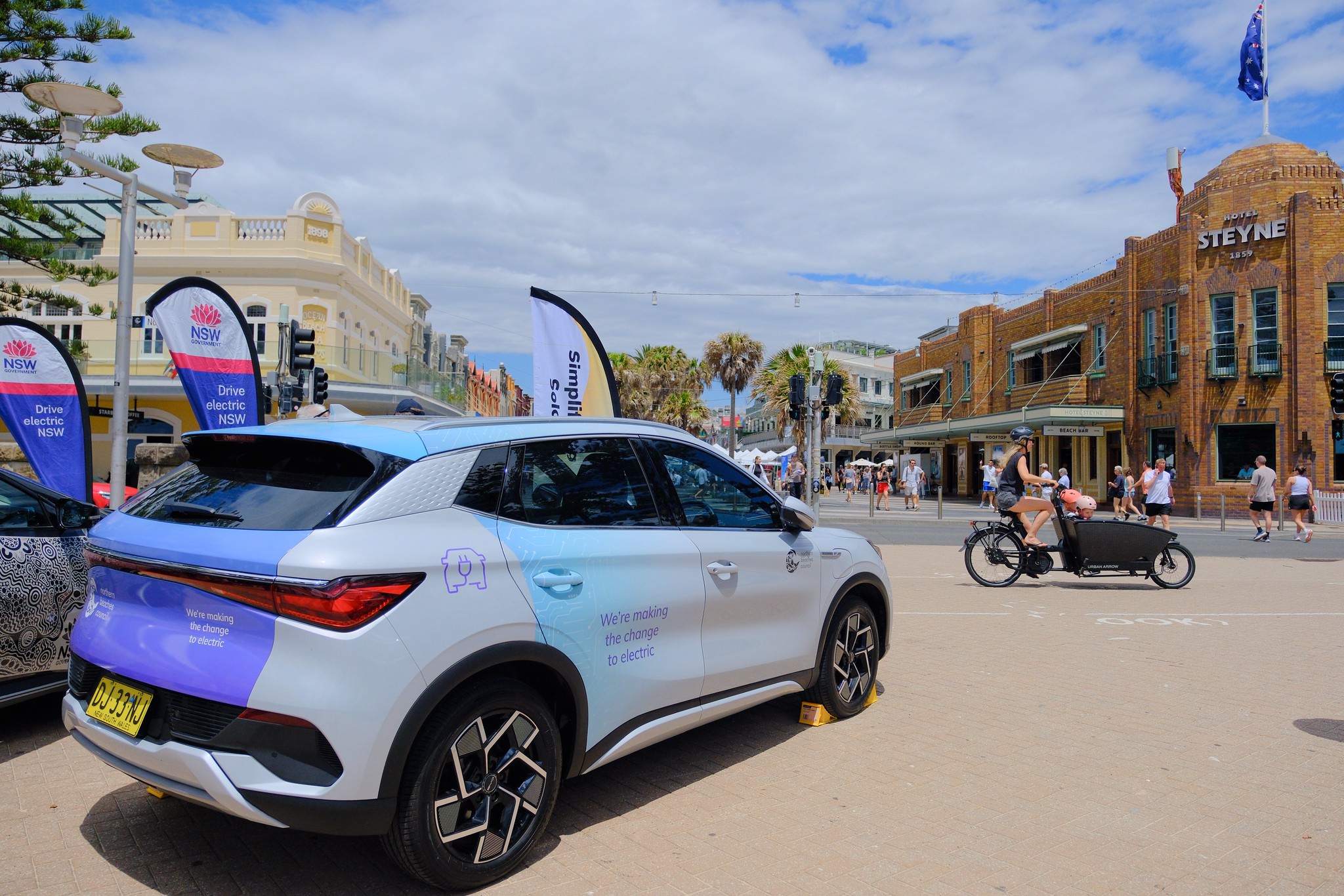
Here, for example, I was waiting for the lady with the cargo bike with two kids, as she was chatting to some people, to ride into this scene of the NSW Energy Roadshow
at the Manly Corso with the Steyne Hotel in the background and an EV in the foreground.
For the thumbnail, I was waiting for some surfers to show, this being Manly Beach, in a scene with some EVs at the same NSW Energy Roadshow.
Colour as a practical tool
One of the most reliable anchoring techniques is colour coordination.
Read the colours already present in your anchor: the orange of a shopfront, the blue and yellow of painted tiles, the red of a traffic light. Then wait for a pedestrian whose clothing — a jacket, a bag, a scarf — echoes one of those colours. The connection is never staged, but when it arrives, the frame feels unified in a way that’s hard to explain technically. Colour is doing relational work across the image, connecting disparate elements without any of them knowing it.
This is slower than it sounds. Most people walking past will not be wearing the right colour. That’s fine. You’re not in a hurry.
Getting comfortable with failure
Scene anchoring does not guarantee results. It improves the odds, over time, for the photographers willing to accept that most sessions at a particular anchor won’t resolve.
The practical position is this: working a scene for forty-five minutes and coming back with nothing usable is not a failed session. It is the structural condition of the practice. You learned what doesn’t work at that anchor. You figured out the light direction, the pedestrian flow, the timing. The next visit to the same spot starts from a less ignorant position.
If a scene doesn’t resolve, photograph it for reference and go back. Trent Parke returns to locations for weeks. The Trafalgar Square image with the pedestrian echoing the stone statues took months of revisiting the same spot before the right person walked through on the right day.
The photographers who improve at this are not the ones with better timing. They’re the ones who got comfortable with showing up repeatedly, failing regularly, and staying curious about what the anchor might eventually produce.
The only decision that matters
Anchoring reframes street photography from a passive to an active discipline. But the core decision — the one that makes it work or not — happens before you press the shutter at all.
What has potential?
Developing the visual sense to answer that question is what the practice is actually training. Which shapes invite rhymes. Which objects invite juxtaposition. Which environments tend to produce unexpected human interaction. You can’t learn that from a checklist. You learn it by making the decision badly a hundred times, then less badly, then occasionally well.
Find something. Stop. Wait. See what the world sends.